I've been fantastically sick the last week or so. Wildly raging sore throat, a head about to explode with sinus pressure, and now, added to it all, i have lost my ability to talk for the last two and a half days. So I've been feeling kind of crummy and just left the computer alone for the most part (which should be an indicator that I'm under the weather!)
Anywho. I had yet another one of those email exchanges with my mom in which she tries to convince me to switch my vote and I try to defend to her my own choices and I got to thinking in the midst of it, how can we live in the same world and yet think that two different things are going to be better for us? How can we be faced with the same reality and yet make such radically different choices?
Today I ran across this article by David Brooks: The Behavioral Revolution It is his thoughts on the financial situation and the four tasks of decision making:
1) perception
2) brainstorm possiblities
3) figure out which is in your best interest
4) act
Now, he talks about how we have focused on number 3 - figuring out what is in our best interest, and while I think in general that is what is in the best interest of the individual, I think that it could also be, what is in the best interest of the business, of the state, of the nation.
Because of Alan Greenspan's deduction that #3 is what failed, (see article for more about financial world), Brooks thinks we need to go all the way back to #1. Perception.
Here is where I finally figured out why my mom and I are having such a hard time right now. She can't believe the choices I would make because she fundamentally believes that they are in the worst interest of our country. And I on the other hand think that her choice is in the worst interest of our country. And so we are arguing about #3 - the best possible course, when we need to go back and look at perception.
I realized this finally, although I had glimpses that something was off skew, reading Brooks' column. But what first tipped me off was listening to the video that she sent me and then looking at the one that I sent her. She sent me: this video by Fred Thompson and I sent back the Colin Powell endorsement
We have such fundamentally different pictures, or perceptions, of the world right now, as it is, different perceptions of reality, that of couse we are making different choices. My question is - 1) can we ever reconcile or come to understand one another's different realities? 2) do we want to? 3) if we live in different worlds, how are we ever going to understand one another?
I guess that is the postmodern dilemma. And ironically, being self-aware about postmodernism helps me to understand that my reality is only a piece of the whole, that everything I percieve is shaped and colored by what I have been able to experience.
This seems very strange, but I was out yesterday getting a prescription filled at Target. And I realized I hadn't eaten lunch yet and also wanted something to sip on. So I stopped at the Target deli and picked up some sushi and a soy chai latte while I was waiting for my perscrption to be filled. It struck me: my parents would never make that choice. My brothers would never make that choice. But I have had experiences in the world that have led me to see sushi as comfort food.
To them, I may just be a latte sipping, tree hugging, sushi-eating liberal. But you know what. That is who I am. That is what my experiences have led me to become. And my experiences aren't better than theirs, they are simply different.
How do we explain ourselves though? How do we explain differences in experience without sounding elitist? How do we share our lives without being offensive? I guess fundamentally, you have to start with sharing - and not in the heat of a political season, but after the waters have cooled, I need to take my mom out for sushi and tell her about my friends in Nashville.
October 29, 2008


October 17, 2008
welcoming the sojourner
I'm attending a conference right now in Illinois about immigration and the church. And I have been incredibly moved by so many of the personal stories, the images and videos of raids and border crossings, the statistics, the songs from across the world, and the witness of people of faith. It has been not only informational but inspirational. (wow, that sounds so cliche).
Before I get too far away or let the thoughts escape me, here are some of the important moments so far for me:
From Rev. Joan Maruskin
Before I get too far away or let the thoughts escape me, here are some of the important moments so far for me:
From Rev. Joan Maruskin
- "I greet you in the name of the migrant, refugee Christ"
- What are three groups that God specifically tells us to care for? The widows, the orphans and the strangers/migrants/foreigners/immigrants
- our journey of faith is a communal migration story
- in 1849, the state of Pennsylvania had a choice between making german or english the official state language. english won by only one vote.
- st. benedict - closing the door to the stranger is closing the door to the sacred
- Jesus' family fled to Egypt after his birth... if they had fled to the US today, Mary, Joseph and Jesus would have all been sent to separate detention facilities to await trials before they would be granted the status of an asylee.
From Diane McClanahan and Barb Dinnen
- immigrants who had fled from Central and Southern American countries where they faced political and religious persecution and those around them were "disappeared" came to the U.S. and in the Swift raids in Marshaltown, Iowa - again faced "disappearance." No clergy, no lawyers, no family was allowed in to see the detainees - and no one knew where they would be taken or what would be done with them.
- The story of Arturo - a young boy whose parents were deported after the Postville raids. His dad wanted him to be a vet, but now, the young boy wants to be a lawyer.
- Recently, ICE agents raided a church in North Carolina.
- From Denny Coon, UM pastor in Iowa: story of a man with two daughters. He makes $5/day in Mexico or he could cross illegally into the U.S. to work for $7/hr at a Wal-Mart in Michigan... what would you do as a parent?
October 15, 2008
politics in the pulpit - and sharing a fantastic story
I'm still amazed of this whole story, and now it is a video. Head over to Jay Voorhees site for this great story for all of us: Red and Blue or watch it below
I'm using it as my children's sermon this Sunday. And I'm using pieces of Noonan's Patriotic Grace. And I'm really excited about the opportunity to talk about politics in the pulpit, but to do so in a way that says Caesar's ways are brutal and nasty and we have the opportunity as Christians to demonstrate to the rest of our country and the rest of the world how we can love. That yes, we should vote, because that is part of our responsibility as citizens - that is what we render to Caesar - but we should never render our souls, we should never render our selves, we should never render our love and our beliefs to the political fight of the world around us.
I'm using it as my children's sermon this Sunday. And I'm using pieces of Noonan's Patriotic Grace. And I'm really excited about the opportunity to talk about politics in the pulpit, but to do so in a way that says Caesar's ways are brutal and nasty and we have the opportunity as Christians to demonstrate to the rest of our country and the rest of the world how we can love. That yes, we should vote, because that is part of our responsibility as citizens - that is what we render to Caesar - but we should never render our souls, we should never render our selves, we should never render our love and our beliefs to the political fight of the world around us.
October 8, 2008
Patriotic Grace
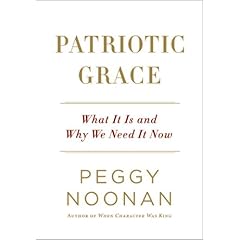
So, I've heard about this book from a variety of places and I decided to buy it yesterday. And I finished it this morning. I think Noonan was a speech writer for Ronald Regan and now writes for the Washington Post. It was really insightful and really made me think about what is necessary - what we have to do as the people of the United States of America to move forward.
Much of her argument is that we had the opportunity to really come together as a nation after 9/11, and for a while we did and we saw in the midst of one of our greatest tragedies our greatest glory. We helped one another out. We demonstrated what Americans were about. And we promised to never forget.
But she talks about actions in the years since then - and some of it she places on carelessness within the administration, but also in the fingerpointing of congress - that have ripped our nation in two. Her book is called patriotic grace because she believes we need to find the maturity and grace to not only listen to and treat others with respect, but also have the grace enough to ask for help when we need it.
I want to post a few thoughts on particular sections of the book in the next week or so, but at least want to get my ideas started.
Have you read the book? What are your thoughts?
October 3, 2008
too much information
, pI just realized that there may actually be too much information going on in this election cycle. We have at least three 24 hour cable news channels. and 3 major networks, + the public network. And how many newspapers and columnists? And how many bloggers? and how many special interest groups? not to mention the campaigns themselves.
I recently sent a 6 page email to my mom in response to her request for reasons why I support Obama. And she sent me back 11 pages of why she disagrees. And in many cases, I have realized that we have different information and that we have different facts. And that all of those facts and information are spun in completely different ways depending on which candidate you are looking at.
It is simply overwhelming. I didn't do a lot of citation of sources and to be honest most of my thoughts in my first email were more ideological, so now I'm trying to figure out how much time and effort I want to spend fact checking and searching out the information I was referring to. It is really and honestly very exhausting.
And what I have realized is the biggest part of how we read all of this information is based on perception. What sources do we percieve to be most relevant? Which do we percieve to be most accurate? less biased? who is more truthful? One of her biggest struggles has been the truthtelling from the Obama camp - so will she believe any of the facts I share? On the other hand, I find many of the ads and the stump speeches from the McCain side to be dishonest. There is so much grey area and each candidate is working as hard as they can to paint the other person in the worst light and they will twist any word or phrase they can to do so.
So even information and facts have to be distilled and researched and examined to find out what was the context, what was the background. And I just don't have the time of day to fact check every single sentence that each candidate and their running mate says. I'm exhausted just thinking about it. Politics, if anything, has served to further divide and hurt us. It pits us against one another. It makes us suspicious. And because there is so much freakin' information out there, the question really is whether any of us will ever again be able to make an informed decision.
I recently sent a 6 page email to my mom in response to her request for reasons why I support Obama. And she sent me back 11 pages of why she disagrees. And in many cases, I have realized that we have different information and that we have different facts. And that all of those facts and information are spun in completely different ways depending on which candidate you are looking at.
It is simply overwhelming. I didn't do a lot of citation of sources and to be honest most of my thoughts in my first email were more ideological, so now I'm trying to figure out how much time and effort I want to spend fact checking and searching out the information I was referring to. It is really and honestly very exhausting.
And what I have realized is the biggest part of how we read all of this information is based on perception. What sources do we percieve to be most relevant? Which do we percieve to be most accurate? less biased? who is more truthful? One of her biggest struggles has been the truthtelling from the Obama camp - so will she believe any of the facts I share? On the other hand, I find many of the ads and the stump speeches from the McCain side to be dishonest. There is so much grey area and each candidate is working as hard as they can to paint the other person in the worst light and they will twist any word or phrase they can to do so.
So even information and facts have to be distilled and researched and examined to find out what was the context, what was the background. And I just don't have the time of day to fact check every single sentence that each candidate and their running mate says. I'm exhausted just thinking about it. Politics, if anything, has served to further divide and hurt us. It pits us against one another. It makes us suspicious. And because there is so much freakin' information out there, the question really is whether any of us will ever again be able to make an informed decision.
October 1, 2008
conversations around ministry
First, I'm so glad that the other young adult clergy in my conference are so outspoken with me. (thanks Allison!)
Second, we had some conversations with our district leadership and two of our Leadership Development Ministers (conference positions that help us all to think about various aspects of ministry) about one of Lovett Weems 10 Provacative Questions - particularly
There were a variety of area clergy and lay people there and in many ways we broke the question down into many different parts.
An example: needing to have three year rotating terms for the Board of Trustees. I am never going to get young people to serve on that committee. They don't want to committ for that amount of time! Short term projects are more desireable. But the whole structure would have to be changed to give the kind of flexibility and grace that is needed (see Lovett Weems question: Can we move from a structure of control to a structure of grace?) We also need to rethink the entire structure of the conference - in today's modern technological and informational world, do we need district finance and district church and society and district this and that? no. their function has been replaced by the conference website.
I guess the piece about this conversation coming immediately after General Conference is that there is some talk about this need for change and flexibility. The structures that we have engrained in our Book of Discipline may have made sense for United Methodism in the United States in the 1960's. But they don't make sense for us today, and they REALLY don't make sense for the United Methodist Church in Nigeria! I have great hopes that the church structure itself will have the room to change as we begin to either a) create regional disciplines or b) simply chop down the Discipline to the things that truly matter - the funadamentals of our church and provide a structure of grace for the church to be what it needs to be in ANY given community.
Second, we had some conversations with our district leadership and two of our Leadership Development Ministers (conference positions that help us all to think about various aspects of ministry) about one of Lovett Weems 10 Provacative Questions - particularly
Can the church change to reach more people, younger people, and more diverse
people?
There were a variety of area clergy and lay people there and in many ways we broke the question down into many different parts.
1) what church are we talking about?Certainly we on the bigger level were talking about the institution which is extremely hard to change. But if we think about the local congregational level, change can be difficult too. What happens when the church is seen as the body of Christ? THEN I think, we start to realize that not only do we need younger people and more diverse people and we must change to include them, but that we need them because we are not complete without them. It is like walking around without an arm, or without a head.
2) are we thinking about growth? success in numbers? fruitfulness?While we think that our church has been in numerical decline since the 1960's, we have actually been in decline as a percentage of the population in the US since the 1880's. But what we talked a lot about is that # of butts in the pew does not equal disciples of Jesus Christ. The point that another young leader and I tried to push was that disciples of Jesus Christ does not also equal butts in a pew. All of us agreed, disciples were the goal and so in many ways, we need a whole different metric for even thinking about the question of how we measure "success" on that front.
3) what kind of change are we talking about?here is the hard part. Each and every church is different and will have to look different as we reach out to the varied populations that we live in. All of us will have to take seriously our context and who is around us: low-income? hispanic? upper middle class blacks? a whole city of 20-30 somethings? One pastor made very clear that we cannot all be a like, and perhaps we simply have to name that and claim that and live authentically the kind of church that we are called to be. Which is absolutely true. But we also wrestled with the fact that it is hard to do that with a structure and a discipline that makes conformity to the rule more desireable than fruitfulness.
An example: needing to have three year rotating terms for the Board of Trustees. I am never going to get young people to serve on that committee. They don't want to committ for that amount of time! Short term projects are more desireable. But the whole structure would have to be changed to give the kind of flexibility and grace that is needed (see Lovett Weems question: Can we move from a structure of control to a structure of grace?) We also need to rethink the entire structure of the conference - in today's modern technological and informational world, do we need district finance and district church and society and district this and that? no. their function has been replaced by the conference website.
I guess the piece about this conversation coming immediately after General Conference is that there is some talk about this need for change and flexibility. The structures that we have engrained in our Book of Discipline may have made sense for United Methodism in the United States in the 1960's. But they don't make sense for us today, and they REALLY don't make sense for the United Methodist Church in Nigeria! I have great hopes that the church structure itself will have the room to change as we begin to either a) create regional disciplines or b) simply chop down the Discipline to the things that truly matter - the funadamentals of our church and provide a structure of grace for the church to be what it needs to be in ANY given community.
Subscribe to:
Posts (Atom)